Osaka Exhibition・Event Venue, Conference Room | ATC Hall

BLOG

Host VIP Conference Dinners in This Private Osaka Bay Venue

By ATC Lounge Editorial

Discover why private venues solve the privacy, dietary, and cultural challenges that hotel ballrooms can't—the Executive's 3-factor test for hosting 15-25 VIP conference guests in Osaka Bay.

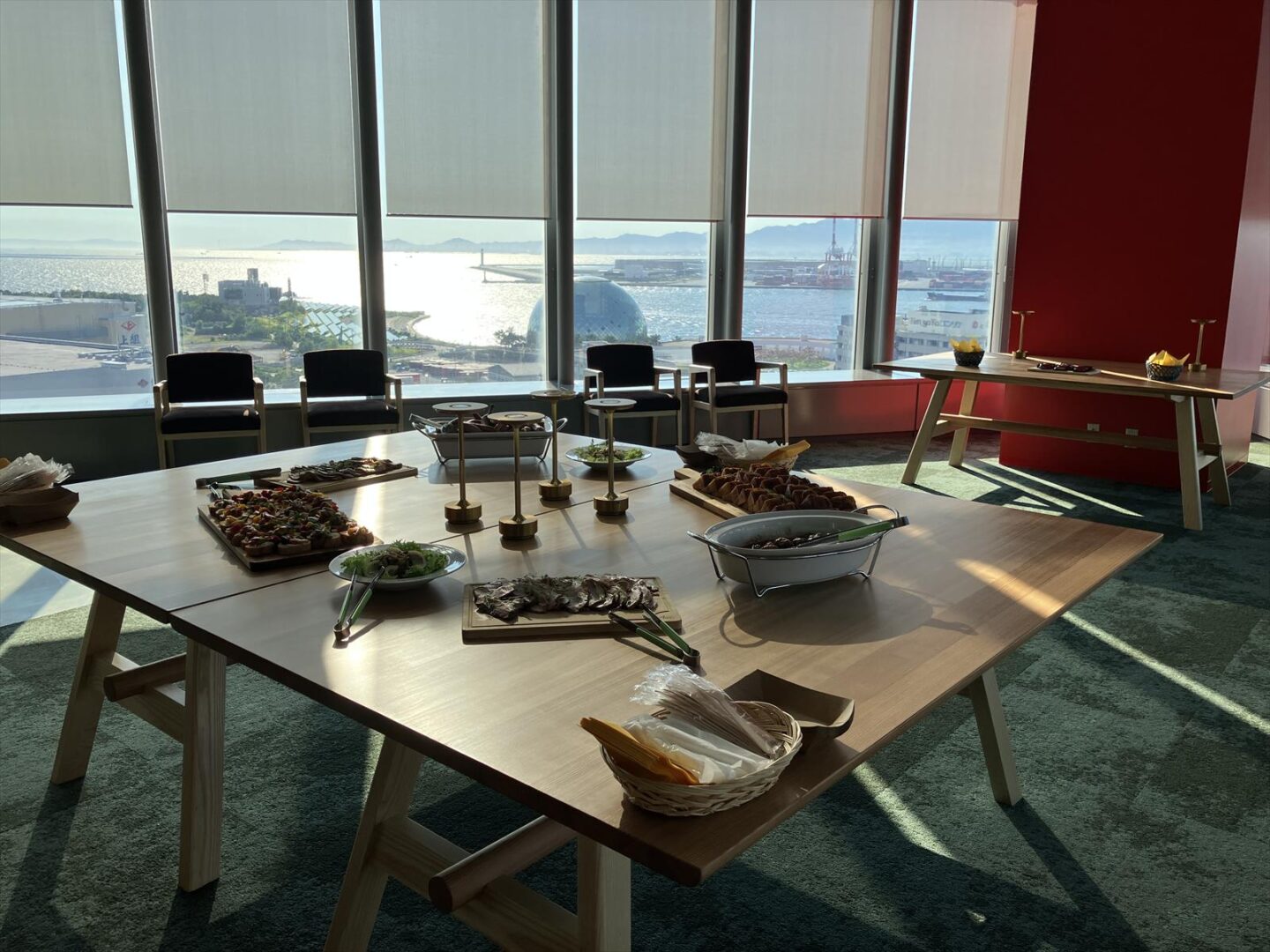
Private executive dining room with floor-to-ceiling windows overlooking Osaka Bay at sunset, elegant table setting for VIP conference dinner

Why Hotel Ballrooms Fail International Conference VIPs

Hotel ballrooms create unavoidable privacy risks through shared lobbies, rigid menus, and kitchen cross-contamination—challenges that compromise both security and cultural sensitivity for high-stakes VIP events.

When hosting international conference VIPs, the "fishbowl effect" poses real operational risks. Luxury hotel guests must navigate crowded lobbies, shared elevators, and public corridors where chance encounters with competitors, media, or other delegates can compromise confidential discussions. Even private dining rooms in hotels typically share thin walls with adjacent events, creating soundproofing concerns for sensitive negotiations.

The International Telecommunication Union's VIP Services Protocol establishes that major international conferences require dedicated lounges with restricted access and fast-track security screening—standards that hotel public spaces cannot consistently meet. Moreover, hotel banquet kitchens serve multiple events simultaneously, creating unavoidable cross-contamination risks for delegates requiring Halal, Kosher, or strict Vegan certification.

According to business protocol consultants specializing in Japan, respecting religious and cultural differences in dining is the key differentiator when entertaining foreign guests for business—yet hotel fixed menus and shared facilities make genuine cultural accommodation difficult to guarantee.

Busy hotel lobby with business travelers and luggage showing privacy challenges for confidential VIP arrivals
The "fishbowl effect" — shared hotel lobbies compromise VIP privacy and discretion

The Three Non-Negotiables for VIP Conference Dinners

Successful VIP conference dinners require absolute privacy protocols, cultural/dietary adaptability, and operational control over ambiance—capabilities that define venue selection criteria for international delegations.

Professional event agencies identify three essential VIP treatment tactics: private arrival points that bypass public spaces, discreet check-in protocols, and unobtrusive security coordination. These protocols protect VIP privacy from arrival through departure, minimizing unwanted visibility and unauthorized access.

For international delegations, VIP protocols must document specific dietary requirements, especially when VIPs belong to different cultural or religious backgrounds. Failure to accommodate these restrictions causes serious offense and damages the business relationships the dinner is meant to strengthen. Beyond dietary needs, venues must provide quiet environments where conversations can be clearly heard—eliminating the noisy, open-plan dining spaces common in busy hotels.

Operational control means authority over scheduling, ambiance, and service flow. Hotel ballrooms impose rigid 2-hour time slots with forced turnover, while VIP strategy sessions often require open-ended discussions that can't be rushed. The ability to control lighting, music, temperature, and even partition space for prayer areas or breakout discussions transforms a venue from passive backdrop to strategic asset.

What Makes a Private Venue Superior for Executive Entertaining

Private venues offering "one group, one venue" exclusivity eliminate shared-space risks while providing dedicated kitchens, flexible scheduling, and neutral territory advantages that hotels structurally cannot match.

The documented "venue gap" in Osaka reveals a critical market inefficiency: most restaurants cap private room capacity at 6-12 guests, while hotel ballrooms require 50-100 minimum bookings. This leaves intimate groups of 15-25 executives—the ideal size for board dinners, strategic planning sessions, and high-value client entertainment—underserved by both restaurant and hotel options.

According to hospitality operators specializing in private function rooms, dedicated private spaces offer exclusivity that standard restaurant seating cannot provide, plus customizable menus accommodating specific dietary preferences without cross-contamination concerns. For confidential business meetings, professional venue operators emphasize that neutral venues outside corporate offices reduce interruption risks and allow discreet handling of attendee arrivals and departures—maintaining confidentiality that office conference rooms compromise.

Private venues with dedicated professional kitchens enable what hotels cannot: genuine Halal certification and Kosher-style preparation by eliminating shared cooking surfaces where pork and alcohol are used for other events. This operational independence is increasingly critical as corporate hospitality adapts to global workforces with diverse requirements.

How to Accommodate Diverse International Delegations

Dedicated kitchens, flexible layouts, and cultural protocol documentation enable private venues to serve Halal, Kosher, Vegan, and prayer-space requirements that shared hotel facilities cannot guarantee.

Current hospitality trends show that 67% of luxury guests now prioritize emotional connection over prestige—meaning cultural sensitivity and values-alignment drive venue selection more than brand recognition. For Muslim delegations, venues must facilitate Halal-certified catering through partnerships with specialized caterers who can verify ingredient sourcing and preparation methods. Hotel shared kitchens create unavoidable cross-contamination risks when pork and alcohol are prepared simultaneously for other banquets.

Beyond dietary requirements, international protocols may require space for pre-meal prayer or specific seating arrangements based on diplomatic hierarchy. Private venues with flexible layouts can partition areas for quiet prayer spaces—a critical need as Expo 2025 organizers have reportedly rejected requests for additional prayer rooms due to space constraints, advising visitors to use hotel facilities instead.

Modern restaurant management research reveals that 78% of diners now rank food quality above cost, with US organic and non-GMO demand up 18% in five years. This shift means venues must offer menu personalization and transparent sourcing—capabilities that fixed hotel packages cannot accommodate. For Jewish delegations requiring Kosher-style preparation, dedicated kitchens allow external certified caterers to work without contamination from non-compliant ingredients.

Japanese hosts entertaining international guests must demonstrate cultural competence while maintaining operational standards. Quiet environments where conversations are clearly heard become essential for deal negotiations and relationship-building—making soundproofing and acoustic design critical venue selection factors.

The Osaka Bay Area Advantage for Conference Hospitality

Osaka Bay venues offer strategic proximity to Kansai International Airport, Expo 2025 sites, and panoramic waterfront views that serve as natural icebreakers for international business discussions.

The Osaka Convention & Tourism Bureau positions the Bay Area as a premier MICE (Meetings, Incentives, Conferences, Exhibitions) destination, with direct transit connections to major conference venues and international accommodation. For Expo 2025, the Yumeshima island venue sits adjacent to the Nanko Bay district, making waterfront locations ideal for delegation hospitality during conference weeks.

Panoramic bay views provide more than aesthetic appeal—they create conversation starters and memorable photo moments that humanize formal business environments. The transition from sunset golden hour to illuminated night skyline offers natural pacing for multi-course dinners, with visual drama that standard hotel ballroom walls cannot replicate. For product launches and brand announcements, floor-to-ceiling windows with motorized reveal features can be choreographed to synchronize with presentations, adding theatrical impact to business moments.

Transportation accessibility matters for VIP logistics. Kansai International Airport serves as Asia's gateway hub, with direct train and limousine connections to Bay Area venues, simplifying arrival coordination for international delegates with tight schedules. Private car access with dedicated parking eliminates the valet queues and public drop-off areas that compromise hotel arrival privacy.

Aerial view of Osaka Bay area showing waterfront venues and transport infrastructure at twilight with illuminated bridge
Osaka Bay at twilight — strategic location near Kansai Airport and Expo 2025 venues

Technology & Security Requirements for Confidential VIP Meetings

Encrypted WiFi, soundproofing specifications, visual privacy controls, and single-entry access points define security baselines for venues hosting sensitive business discussions.

Workspace security analysts identify four essential security features for confidential meetings: soundproofing to prevent acoustic eavesdropping, encrypted WiFi networks to protect data transmission, visual privacy through window treatments or strategic positioning, and access restrictions limiting entry to authorized attendees only. Hotels with shared lobbies and multiple event spaces cannot effectively control who observes attendee arrivals or overhears corridor conversations.

Modern corporate venue requirements include strong WiFi (100+ Mbps), integrated AV systems, and hybrid meeting capabilities for remote participant inclusion. Technology failures during VIP events cause reputational damage, making backup internet connections and redundant AV systems critical infrastructure—not optional amenities.

For C-suite strategy sessions involving merger discussions, product launches, or confidential negotiations, soundproofing becomes a measurable requirement, not a vague promise. Professional venues should provide Noise Reduction Coefficient (NRC) ratings for walls and doors, demonstrating acoustic isolation from adjacent spaces. Single-entry configurations with controlled elevator access prevent the "hallway encounter" risk where attendees might be photographed or questioned by journalists covering the same conference.

Visual privacy extends beyond drawn curtains—strategic positioning away from public sightlines and the ability to control all window treatments ensures conversations cannot be observed or lip-read from nearby buildings. For multinational negotiations, these security protocols aren't luxury preferences—they're operational requirements that protect intellectual property and competitive positioning.

Culinary Control: Why BYO Chef Changes Everything

Professional kitchens enabling "bring your own chef" policies eliminate hotel markup penalties and cross-contamination risks while enabling chef's table experiences that standard banquet menus cannot replicate.

The rise of private chef services and chef's table experiences reflects corporate demand for "eatertainment"—multi-sensory dining with interactive storytelling that transforms meals from passive consumption to memorable experiences. Hotels charging 300-400% markups on wine and prohibiting outside catering protect their F&B revenue but constrain client creativity and budget efficiency.

Private venues with fully equipped professional kitchens—including IH stoves, commercial refrigeration, and service counters—enable clients to hire specialized chefs for sushi omakase experiences, French molecular gastronomy, or fusion menus tailored to delegate preferences. This operational flexibility matters financially: a corporate dinner serving 10 bottles of vintage wine could save $5,000+ by avoiding hotel corkage fees, directing budget toward higher food quality or upgraded presentation.

For international delegations, the ability to fly in a celebrity chef or use a delegation's preferred caterer provides culinary diplomacy advantages that fixed hotel menus cannot match. Japanese kaiseki masters, Michelin-starred French chefs, or certified Halal specialists can work in dedicated kitchens without the scheduling conflicts and cross-contamination concerns of shared hotel banquet facilities.

The chef's table format—where preparation becomes performance—creates natural conversation icebreakers during the awkward early minutes of VIP dinners. Watching a sushi master slice toro or a pastry chef construct a dessert centerpiece provides shared experiences that facilitate relationship-building more effectively than forced small talk in hotel ballrooms.

Elegant intimate private dining room setup with panoramic bay views and professional table setting for VIP conference dinner
Private dining designed for 15-25 executives — intimate, quiet, and completely confidential

When to Choose a Private Venue Over a Hotel: Decision Matrix

If your event meets two or more criteria—confidentiality priority, cultural/dietary complexity, or 15-25 guest intimacy—a private venue likely outperforms hotel ballrooms.

The decision framework centers on three factors. First, confidentiality priority: when discussion topics involve M&A strategy, legal matters, or proprietary information, and when attendees must not be photographed together due to competitive concerns, information leakage risk outweighs hotel convenience. Choose venues with soundproofing, restricted access, and zero overlap with other events.

Second, cultural/dietary complexity: when multiple religious requirements (Halal + Kosher + Vegan) must be accommodated simultaneously, when cross-contamination risk is unacceptable, or when prayer space or specific cultural protocols are required, choose venues with dedicated kitchens and flexible layouts that hotels cannot guarantee.

Third, intimate group size (15-25 guests): when hotel ballrooms feel empty or impose 50+ minimums, when restaurant private rooms are too cramped (6-12 max), and when you want "executive boardroom" intimacy rather than "conference hall" scale, boutique private venues purpose-built for this range deliver superior experiences.

Conversely, if your event serves 50+ guests, is public-facing, or has standard dietary needs, hotels may offer better economies of scale through bulk catering and established service teams. The venue decision must align with event objectives—prioritizing relationship quality over cost efficiency for high-stakes VIP hospitality.

For Osaka Bay venues like ATC Lounge, the 160㎡ space accommodates 15-25 guests optimally—large enough to feel significant, intimate enough for meaningful conversation. Pricing transparency matters: venue-only rentals typically range ¥180,000-200,000, while full culinary packages with external catering reach ¥300,000+—comparable to hotel ballroom base rates before hidden AV rental, corkage, and overtime fees compound final costs.

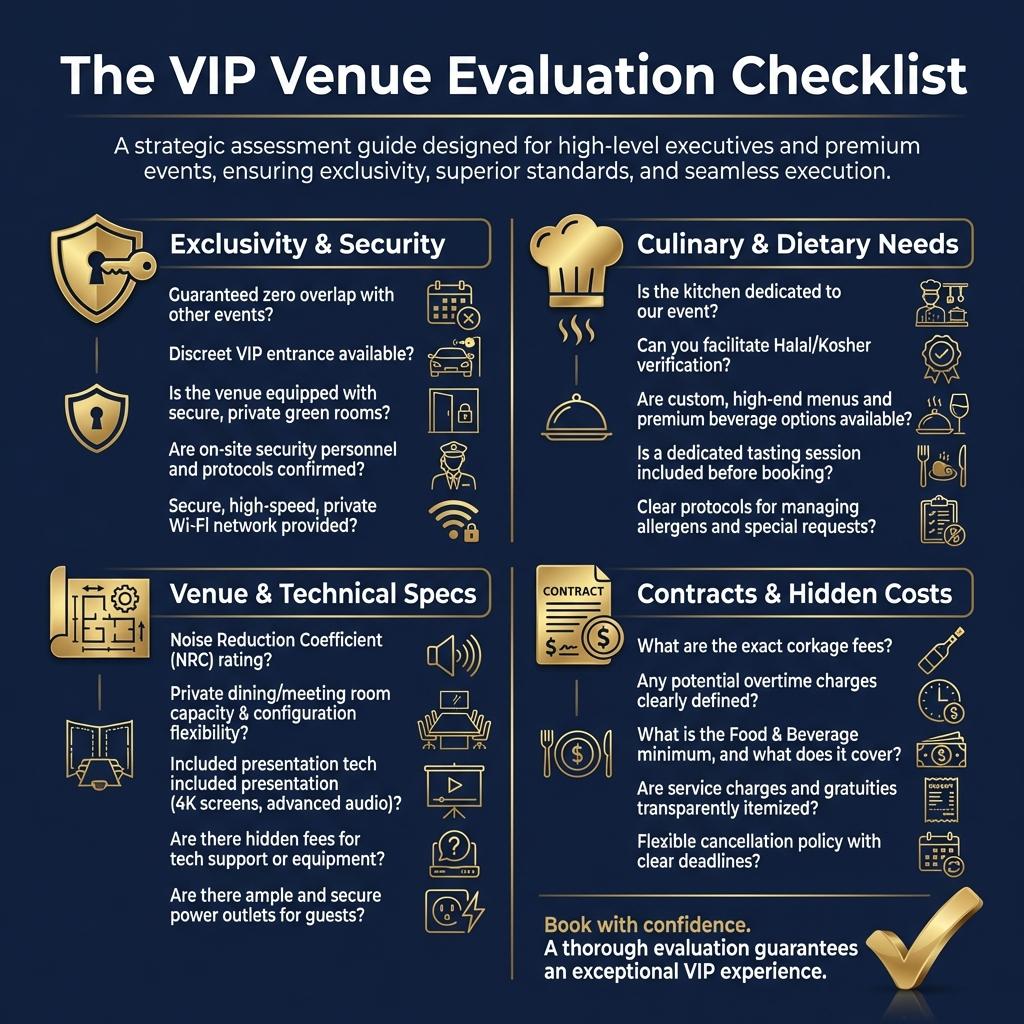
Professional venue selection checklist showing security, privacy, and dietary compliance assessment criteria for VIP event planning
Venue evaluation checklist — essential criteria for VIP-ready private spaces

Budgeting Transparency: True Cost Comparison

Hotel banquets advertise lower base rates but accumulate hidden fees (AV rental, corkage, overtime) that private venues avoid through transparent all-inclusive pricing structures.

Hotel ballroom pricing often obscures total costs through separate line items. AV equipment rental (projectors, microphones, screens) adds ¥50,000-100,000 to base venue fees. Wine corkage fees of ¥3,000-5,000 per bottle create staggering charges when entertaining wine-focused clients—a 10-bottle dinner incurs ¥30,000-50,000 in corkage alone, plus the 300-400% markup if purchasing from hotel wine lists.

Overtime charges penalize events running beyond contracted hours—common when VIP discussions extend naturally beyond rigid 2-hour windows. Setup and breakdown fees, mandatory service charges (often 10-15%), and per-person minimum F&B spends further inflate final invoices. For a 20-person VIP dinner, total hotel costs frequently reach ¥400,000-500,000 after all surcharges.

Private venue models offer pricing transparency: venue rental (¥180,000-300,000) plus external catering (¥10,000-15,000 per person) totals ¥380,000-600,000 for 20 guests, with zero corkage penalties for bringing preferred wines. This pricing includes full-day access, eliminating overtime charges, and allows flexible scheduling that accommodates VIP travel delays or extended discussions.

The ROI calculation extends beyond invoice comparison. Relationship quality, deal closure rates, and repeat business value matter more than upfront cost savings for high-stakes corporate hospitality. A private venue enabling 4-hour unrushed discussion in complete privacy delivers higher strategic value than a 2-hour hotel time slot where conversations feel monitored and rushed.

Operational Logistics: From First Contact to Flawless Execution

Professional private venues provide inquiry-to-execution support including site visits, chef coordination, dietary verification, contingency planning, and day-of logistics management.

The venue selection process begins 3-6 months before international conferences—allowing time for dietary certification verification, cultural protocol documentation, and chef partnership coordination. Last-minute bookings (under 4 weeks) severely limit customization options and increase costs as vendors charge premiums for compressed timelines.

Initial inquiry should include: attendee count, dietary restrictions (specific certifications required), event date flexibility, budget parameters, and confidentiality requirements. Professional venues respond with floor plans showing capacity configurations, equipment lists detailing included AV infrastructure, and transparent pricing breakdowns itemizing all fees.

Site visits allow physical inspection of arrival protocols (private entrance vs. shared lobby), soundproofing quality, kitchen capabilities, and view sightlines. During visits, request introductions to recommended caterers or chef partners, and discuss contingency plans for weather impacts (if outdoor elements exist), dietary emergencies, or last-minute guest count changes.

Day-of logistics require coordination between venue staff, external caterers, security teams (if VIP protection is needed), and AV technicians. A dedicated venue coordinator should manage vendor access, equipment testing, and timeline adherence—allowing the event host to focus on guest relationships rather than operational troubleshooting.

For urgent venue inquiries, the ATC Hall contact page provides direct channels for discussing specific event requirements and availability confirmation.

Interactive chef's table experience showing live food preparation for VIP corporate dinner guests in a private venue setting
Chef's table experiences transform passive dining into memorable multi-sensory entertainment

Frequently Asked Questions

What makes a venue suitable for hosting VIP conference dinners?

Essential features include complete privacy (no shared spaces), security protocols (soundproofing, restricted access), cultural/dietary accommodation capabilities (dedicated kitchen), and discreet arrival/departure handling.

Suitable venues eliminate the "fishbowl effect" by providing single-entry access, dedicated elevator service, and one-group-only rental policies. Soundproofing prevents acoustic eavesdropping, while encrypted WiFi protects data transmission during hybrid meetings. Cultural accommodation requires dedicated kitchens where certified Halal or Kosher caterers can work without cross-contamination from other events. Professional arrival protocols include private parking, valet coordination, and bypassing crowded lobbies where VIP attendees might be photographed. These operational capabilities define suitability beyond aesthetic appeal.

Why do private venues work better than hotel ballrooms for 15-25 person executive dinners?

Hotels require 50-100 guest minimums (making small groups awkward), impose rigid menus with high markups, and share kitchen facilities that risk dietary cross-contamination—while private venues offer purpose-built intimacy and culinary control.

The documented venue gap shows most restaurants cap private rooms at 6-12 guests while hotels optimize for large groups. A 20-person dinner in a 200-capacity ballroom feels sparse and lacks intimacy essential for relationship-building conversations. Hotel fixed menus with 300-400% wine markups constrain menu personalization, while shared banquet kitchens simultaneously prepare pork dishes and Halal meals—creating unacceptable contamination risks. Private venues designed for 15-25 capacity provide "executive boardroom" scale where everyone can converse naturally without shouting across vast spaces.

What's the typical cost difference between hotel banquets and private venue rentals?

Hotel banquets appear cheaper initially but add hidden costs (300-400% wine markups, AV rental, overtime charges)—while private venues charge transparent rental fees (¥180k-300k in Osaka Bay) plus external catering, often totaling similar or lower with greater flexibility.

Hotel pricing obfuscates total costs through separate line items. A ¥250,000 ballroom base rate accumulates AV rental (¥75,000), corkage fees for 10 bottles (¥40,000), overtime charges for 1 extra hour (¥50,000), and mandatory 15% service charge (¥62,000)—totaling ¥477,000. Private venue models quote ¥200,000 venue rental plus ¥12,000/person catering for 20 guests (¥240,000)—total ¥440,000 with zero corkage, flexible scheduling, and complete menu control. The value proposition extends beyond price: relationship quality in private, unrushed environments delivers higher ROI for high-stakes VIP hospitality.