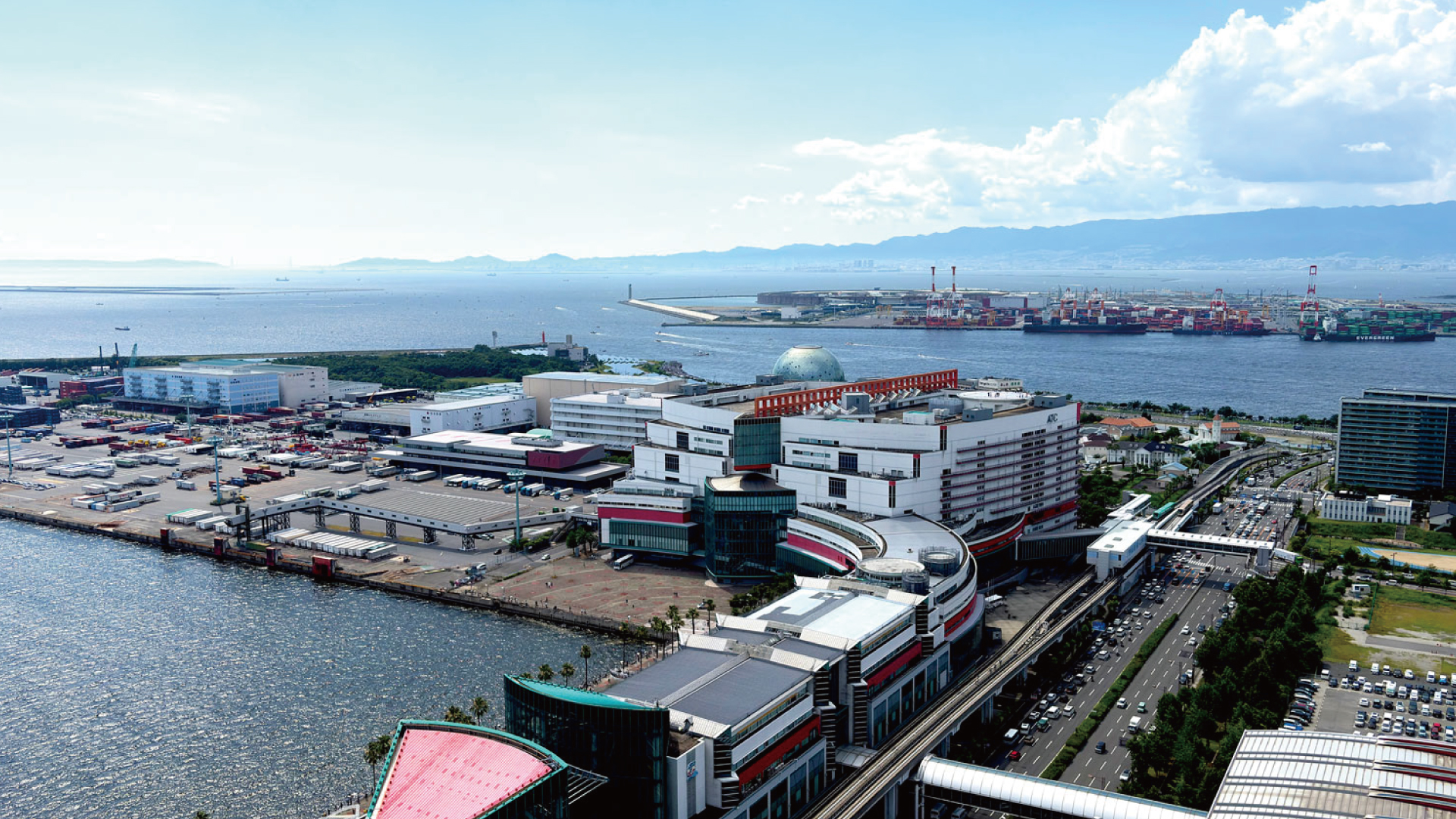
Discover why Osaka Bay is the smart choice for international conferences after Expo 2025. Mid-scale venues, English support, waterfront settings, and IR 2030 momentum.
Expo 2025 Osaka-Kansai concluded in October 2025 after welcoming 29 million visitors, dramatically revitalizing the region's MICE infrastructure with upgraded transport, hotels, and international partnerships that now benefit conference organizers.
The Osaka Convention & Tourism Bureau confirmed that events launched during the Expo continue into 2026, with international planners newly choosing Osaka over traditional destinations. Japan's MICE market is projected to grow to USD 2.0 billion by 2033. According to Osaka Convention & Tourism Bureau, Osaka Bay now positions itself as "Western Japan's largest event space."
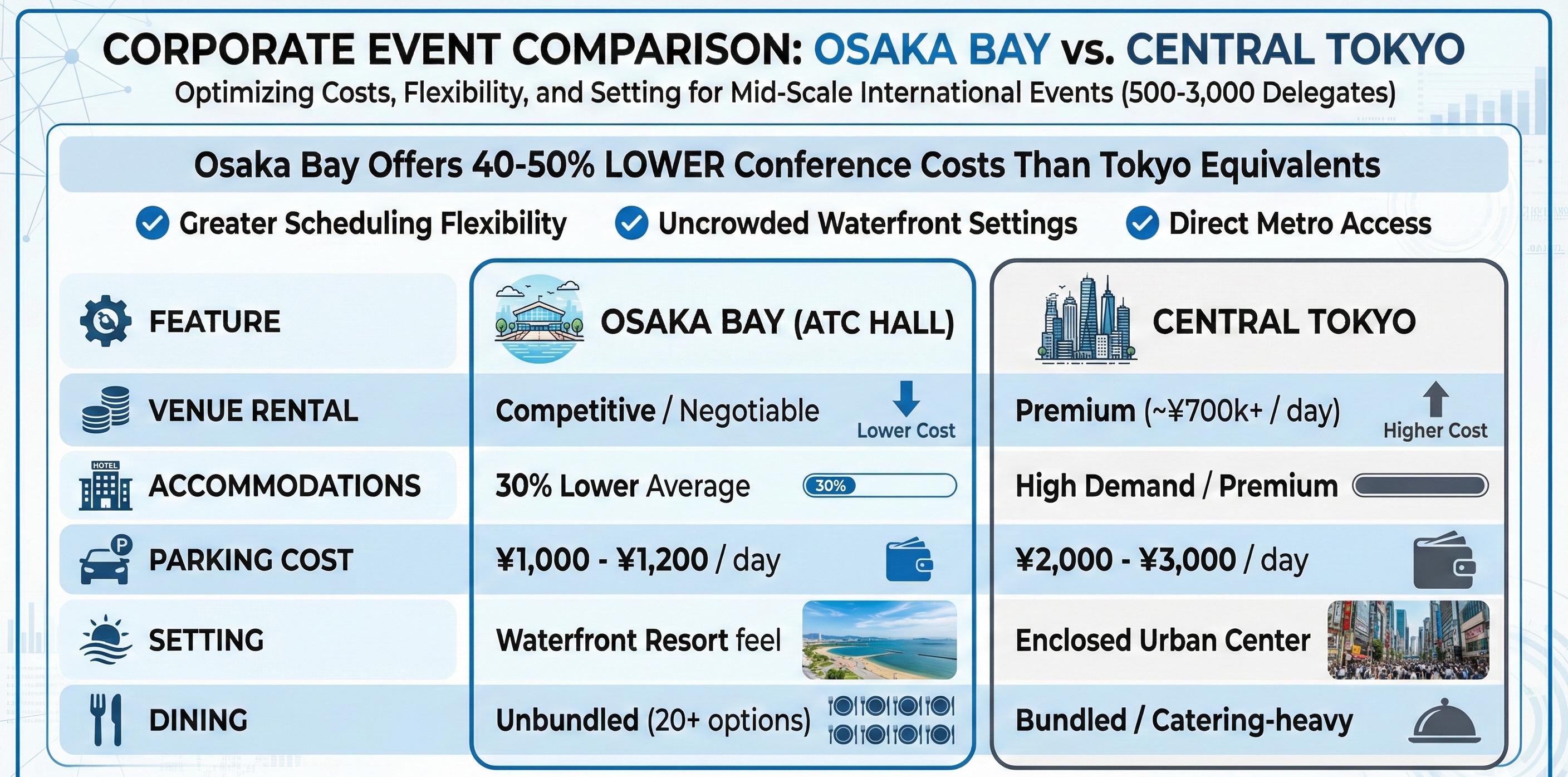
Osaka Bay offers 40-50% lower conference costs than Tokyo equivalents, with greater scheduling flexibility, uncrowded waterfront settings, and direct metro access—ideal for mid-scale international events requiring 500-3,000 delegates.
| Feature | Osaka Bay (ATC Hall) | Central Tokyo |
|---|---|---|
| Venue Rental | Competitive / Negotiable | Premium (~¥700k+ / day) |
| Accommodations | 30% Lower Average | High Demand / Premium |
| Parking Cost | ¥1,000 - ¥1,200 / day | ¥2,000 - ¥3,000 / day |
| Setting | Waterfront Resort feel | Enclosed Urban Center |
| Dining | Unbundled (20+ options) | Bundled / Catering-heavy |
A detailed cost analysis by Japan Meetings found that Osaka venues provide significant savings on venue rental, audiovisual equipment, and accommodation. Beyond costs, detailed hall specifications and capacity charts show that Osaka Bay offers specialized spaces that Tokyo's enclosed convention centers can't match.
Central Osaka venues excel for walk-in traffic but struggle with parking and crowded metro lines. Osaka Bay inverts this: 1,200 indoor parking spaces, less congested transit, and 20+ on-site restaurants that eliminate expensive catered lunch contracts.
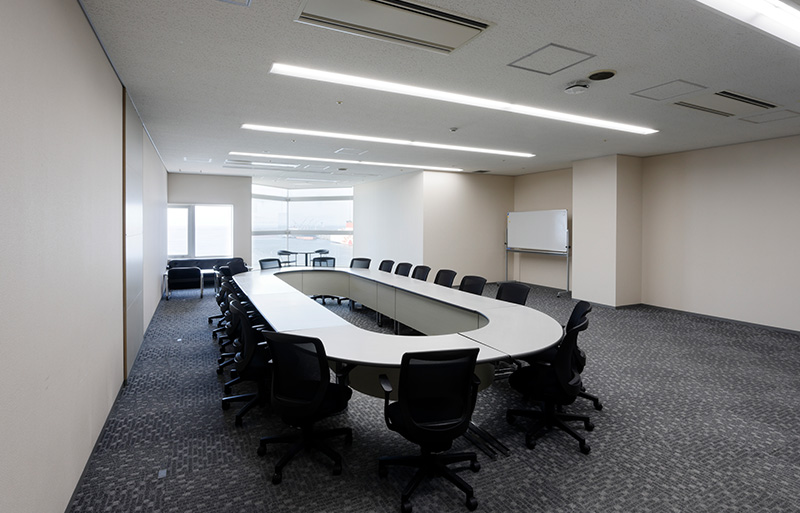
ATC Hall provides 7,000㎡ across five versatile halls (10-3,600 capacity), 12 conference rooms, and museum-grade exhibition spaces—filling the gap between hotel ballrooms and mega-exhibition centers.
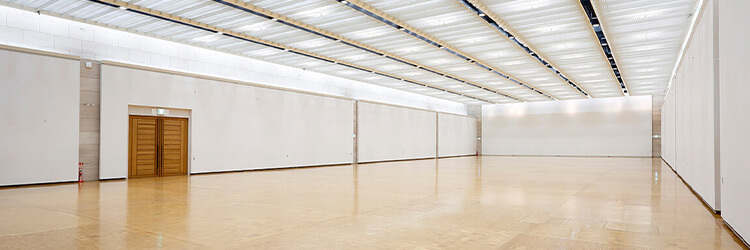
Spanning 2,900㎡ with 8-meter ceilings, Hall A accommodates 3,600 theater-style or 2,500 school-style. Subdividable into 1,600㎡ and 1,300㎡ sections for concurrent programming.
Offers museum-quality wooden flooring and variable LED lighting (1,140-2,710 lux), ideal for art exhibitions or luxury brand showcases.
Located 18 minutes from Honmachi Station, ATC Hall connects directly to Trade Center-mae Station through covered walkways. Grand Prince Hotel Osaka Bay sits within 3-minute walk, enabling morning keynotes at 9:00 AM with 8:50 AM hotel departures.
Review detailed hall specifications and capacity charts or download printable floor plans and technical specifications for your planning sessions.
ATC Hall provides bilingual event coordinators from inquiry through event day, addressing the 70% language barrier challenge that deters international planners from Japanese venues.
Services include full English correspondence, floor plan consultations, and on-site troubleshooting. Technical infrastructure supports hybrid events with high-speed Wi-Fi and individual user authentication for secure 4K streaming.
For step-by-step guidance, consult our English event planning guide, covering initial inquiry to post-event logistics.
Osaka's Integrated Resort (IR) breaks ground April 2025 with autumn 2030 opening, bringing a 6,000-seat conference center and ¥1.27 trillion investment to Yumeshima island—adjacent to current Bay Area venues.
Choose Osaka Bay if your conference is 500-3,000 delegates, multi-day, requires English coordination, and prioritizes cost-efficiency.
ATC Hall's 1,200 indoor parking spaces cost 40-50% less than central Osaka parking, with weather-protected access.
Transport is predictable: an 18-minute Chuo Line ride from Honmachi avoids the city's most congested routes. For international delegates, the covered walkway from Trade Center-mae station ensures a comfortable arrival.
Plan your arrival with our comprehensive access and transportation guide.